When choosing a Python web framework, Flask and FastAPI are two of the most popular options. While both enable you to build robust web applications, their architectural philosophies differ significantly. Differences that become strikingly clear when you analyze their code structure.
Meet Flask: The Micro Framework
Flask, created by Armin Ronacher in 2010, bills itself as a "micro" framework. The philosophy is simple: provide the bare essentials for routing and request handling, then let developers choose their own tools for everything else.
Flask's core is deliberately minimal. There's no built-in ORM, no form validation library, and no opinionated structure. Instead, you get a lightweight foundation and the freedom to compose your application from whatever libraries you prefer. This simplicity has made Flask a favorite for small projects, prototypes, and developers who value explicit control.
from flask import Flask, jsonify

app = Flask(__name__)

@app.route('/api/users/')
def get_user(user_id):
    # Simple, straightforward routing
    return jsonify({"id": user_id, "name": "Alice"})

if __name__ == '__main__':
    app.run(debug=True)
Enter FastAPI: The Modern Async Framework
FastAPI, released in 2018 by Sebastián Ramírez, takes a different approach. Built on top of Starlette and Pydantic, it embraces modern Python features like type hints and async/await to deliver automatic request validation, serialization, and interactive API documentation out of the box.
FastAPI doesn't just handle HTTP requests—it understands them. By leveraging Python's type system, it can automatically validate incoming data, generate OpenAPI schemas, and provide detailed error messages when something goes wrong. This "batteries-included" philosophy dramatically reduces boilerplate code.
from fastapi import FastAPI
from pydantic import BaseModel

app = FastAPI()

class User(BaseModel):
    id: int
    name: str

@app.get("/api/users/{user_id}", response_model=User)
async def get_user(user_id: int):
    # Type-safe routing with automatic validation
    return User(id=user_id, name="Alice")
The Architectural Divide
The philosophical differences between Flask and FastAPI manifest clearly in their codebases. Let's examine this through the lens of static analysis.
Flask: Centralized Complexity
When you analyze Flask's source code, a distinct pattern emerges. Despite being called a "micro" framework, Flask concentrates significant complexity in a relatively small codebase.
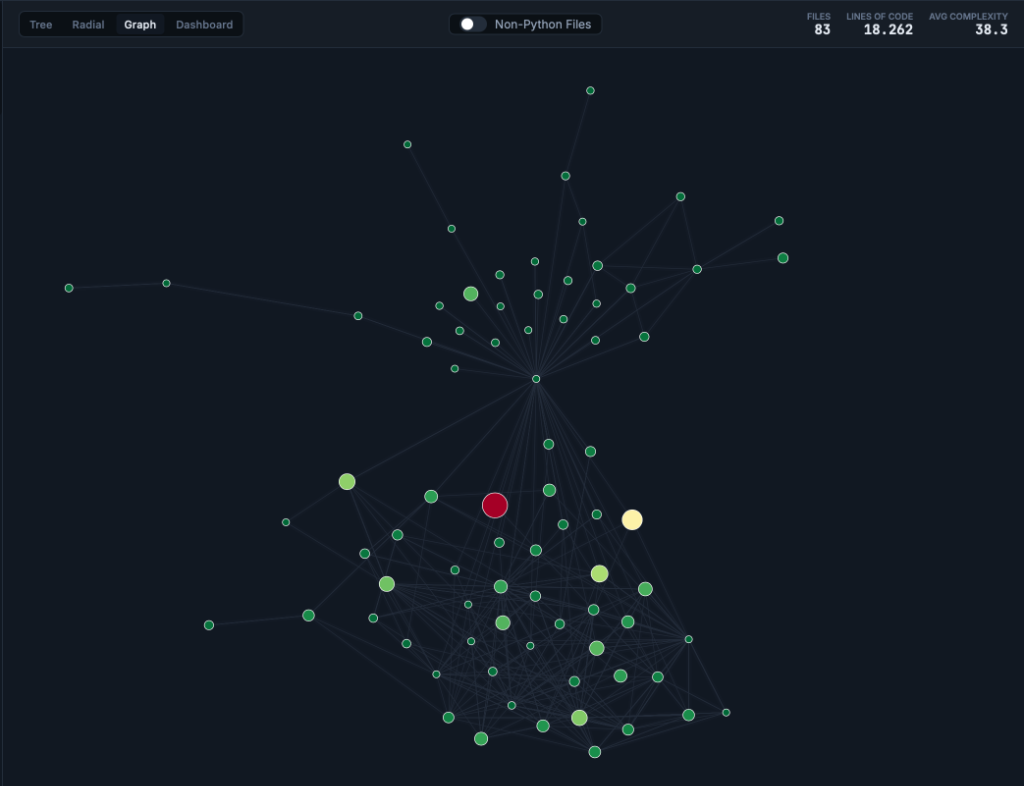
The dependency graph reveals a tightly coupled, hub-and-spoke architecture. Flask contains 83 files with 18,262 lines of code, but the average cyclomatic complexity per file is a striking 38.3. This indicates that individual modules are doing a lot of heavy lifting, with many conditional branches and interconnected logic paths.
This centralized design is a double edged sword. On one hand, it keeps the framework compact. On the other, it makes individual components more complex and harder to understand in isolation. When everything flows through a few core modules, changes ripple outward unpredictably.
FastAPI: Distributed Modularity
FastAPI takes the opposite approach. Its architecture is deliberately modular, distributing responsibility across a much larger number of focused, single-purpose files.
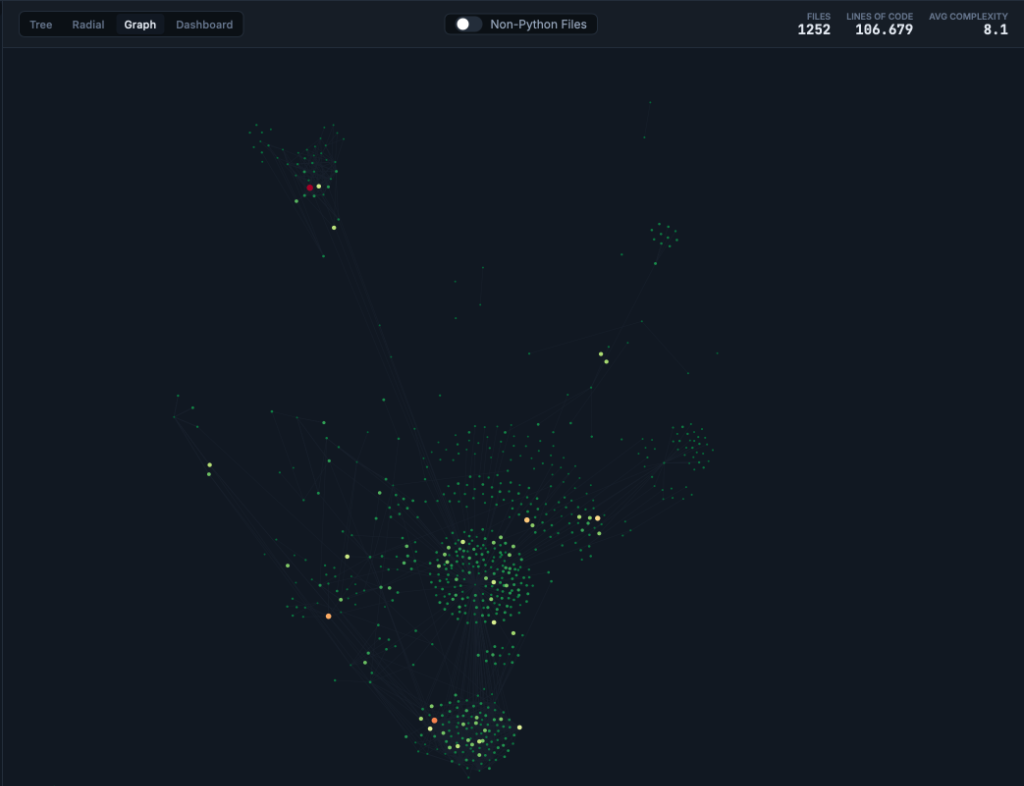
The numbers tell a compelling story: 1,252 files, 106,679 lines of code, and an average complexity of just 8.1 per file. Despite being a much larger codebase, each individual module is dramatically simpler.
This distributed architecture creates clear separation of concerns. Routing logic lives separate from validation logic. Type handling is isolated from serialization. Each module has a well-defined purpose and minimal conditional complexity, making the codebase easier to navigate, test, and extend.
Why does modularization matter? When code is broken into small, focused modules, each piece becomes easier to understand, test, and modify. Changes are localized, reducing the risk of unexpected side effects. This is the essence of maintainable software.
The Maintainability Paradox
Here's where it gets fascinating. When we run both codebases through a maintainability analyzer, FastAPI achieves a perfect score of 100, while Flask scores 0—despite Flask being the smaller, ostensibly "simpler" framework.
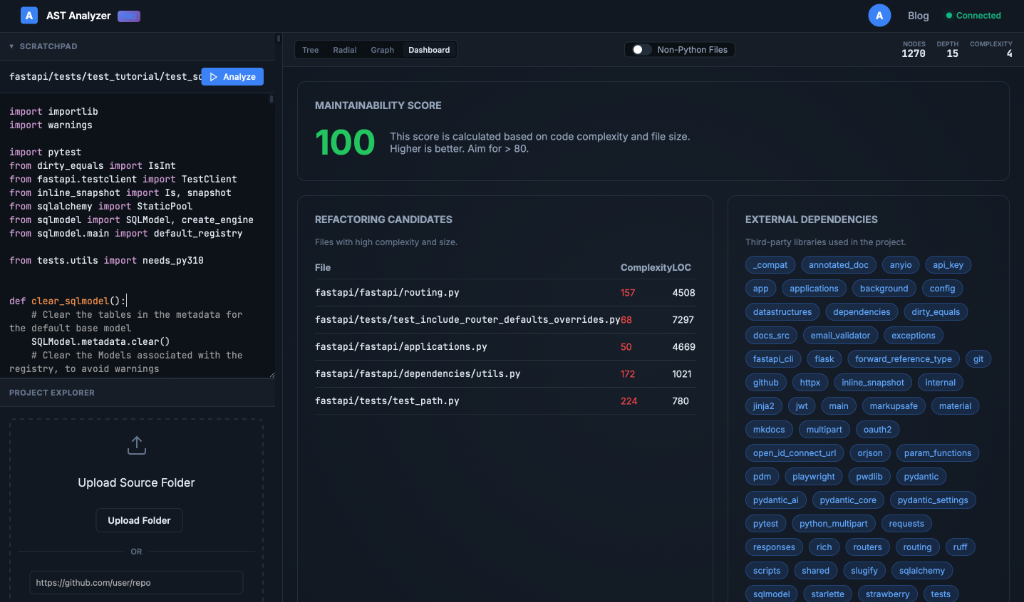
How can this be? The maintainability score is calculated based on cyclomatic complexity and file size. FastAPI's exceptional modularization means that even though the project is larger overall, no individual file is particularly complex or unwieldy.
Flask's centralized approach means that core modules pack in substantial logic. When a single file handles routing, context management, and request processing, its complexity score skyrockets. This makes those files harder to modify confidently, harder to test thoroughly, and more prone to hidden bugs.
Refactoring Candidates
The maintainability analysis identifies Flask's most complex modules as prime refactoring targets:
flask/app.py- The central application object with extensive conditional logicflask/blueprints.py- Blueprint registration and routing mechanicsflask/cli.py- Command-line interface with numerous options and branches
In contrast, FastAPI's refactoring candidates have much lower complexity scores. The framework's design naturally prevents any single module from becoming a maintenance bottleneck.
What This Means for Your Projects
These architectural differences have real-world implications:
- For small projects and prototypes, Flask's simplicity and minimalism can be ideal. You write less code upfront, and the entire framework fits in your head.
- For production APIs and larger applications, FastAPI's modular architecture pays dividends as your codebase grows. The type safety, automatic validation, and maintainable structure reduce bugs and onboarding time.
- For teams, FastAPI's clear separation of concerns makes it easier for multiple developers to work in parallel without stepping on each other's toes.
It's worth noting that Flask's low maintainability score doesn't mean it's "bad" code—it reflects philosophical choices about where complexity should live. Flask concentrates complexity in the framework itself to keep your application code simple. FastAPI distributes complexity across many modules, making the framework itself more maintainable at the cost of being larger.
The Verdict
There's no universal winner here. Flask remains an excellent choice for lightweight applications where you want full control and minimal dependencies. Its battle-tested stability and enormous ecosystem make it a safe bet.
FastAPI shines when you need type safety, automatic API documentation, and a codebase that scales gracefully. Its superior modularity makes it easier to maintain over time, especially as projects grow and teams expand.
The key insight from this analysis: lines of code and project size don't tell the full story. What matters is how complexity is organized. FastAPI's distributed architecture proves that a larger codebase can be more maintainable than a smaller one—if it's structured well.
Analyze Your Own Codebase →