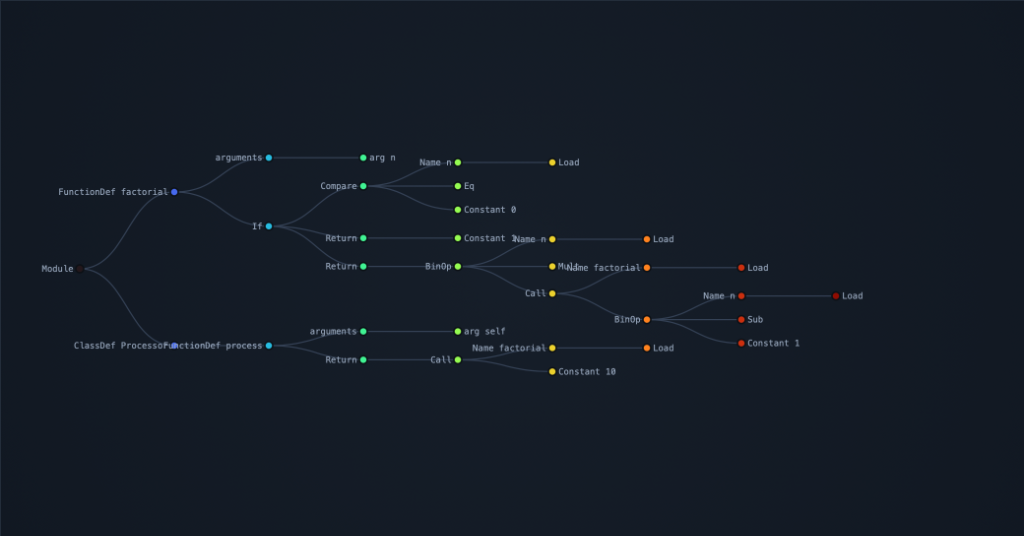
If you've ever wondered how a computer actually reads your code, the answer lies in a data structure called the Abstract Syntax Tree (AST).
When you write code in a language like Python, the interpreter doesn't just execute the raw text. It first goes through a multi-stage process called parsing. This begins with lexical analysis, where your code is broken down into a stream of "tokens"—the fundamental building blocks like keywords, operators, and literal values.
From Tokens to Trees
After tokenization, the syntactic analysis phase begins. This is where the magic happens. The parser takes that flat stream of tokens and organizes them into a hierarchical tree-like structure that reflects the grammar of the language. This tree is what we call an AST.
Consider a simple line of Python:
x = 10 + 5To an AST, this isn't just a string of characters. It's an Assign node, which possesses two
distinct children: a Name node representing the variable x, and a
BinOp
(Binary Operation) node. The BinOp node itself contains the operator Add and
two Constant nodes for the values 10 and 5.
Why "Abstract"? An AST is called abstract because it ignores incidental syntax details—like parentheses, semicolons, and whitespace—that are necessary for writing code but don't change its fundamental meaning. This allows static analysis tools to focus purely on the logic.
Real-World Power: Where ASTs Live
AST analysis isn't just a theoretical concept; it powers almost every modern developer tool you use today:
- Linters (ESLint, Flake8): These tools traverse your AST to find patterns that match known errors or stylistic issues without ever actually running your code.
- Transpilers (Babel, SWC): They convert modern JavaScript into older versions by modifying the nodes of your AST to achieve the same result with different syntax.
- Formatters (Prettier): By reconstructing code directly from the AST, they preserve the logic while enforcing a perfectly consistent visual style.
- Optimizers: Compilers use ASTs to find dead code, unroll loops, and perform millions of tiny optimizations that make your software faster.
The Value of Visualization
Reading complex code as flat text is like trying to understand a city's layout from a street-level view alone. Visualizing an AST provides a "satellite view" of your program. It reveals the true depth of nested logic, uncovers hidden complexity in recursive functions, and helps you understand exactly how decorators and context managers are wrapping your core operations.
By turning these abstract concepts into concrete, interactive graphs, we move beyond just "writing" code and start truly "architecting" it.
Launch AST Analyser →